Every order starts with a drawing you approve — nothing is cut until you say yes.Every order starts with a drawing you approve.

Channel letters guide

Channel letters: the complete guide

What channel letters are, how they are built, which lighting style to choose, and what to know about size, cost, permits, installation and care. In plain English, in one place.

  • ✓ 304 stainless steel
  • ✓ Flush to the wall
  • ✓ Drawing before you pay
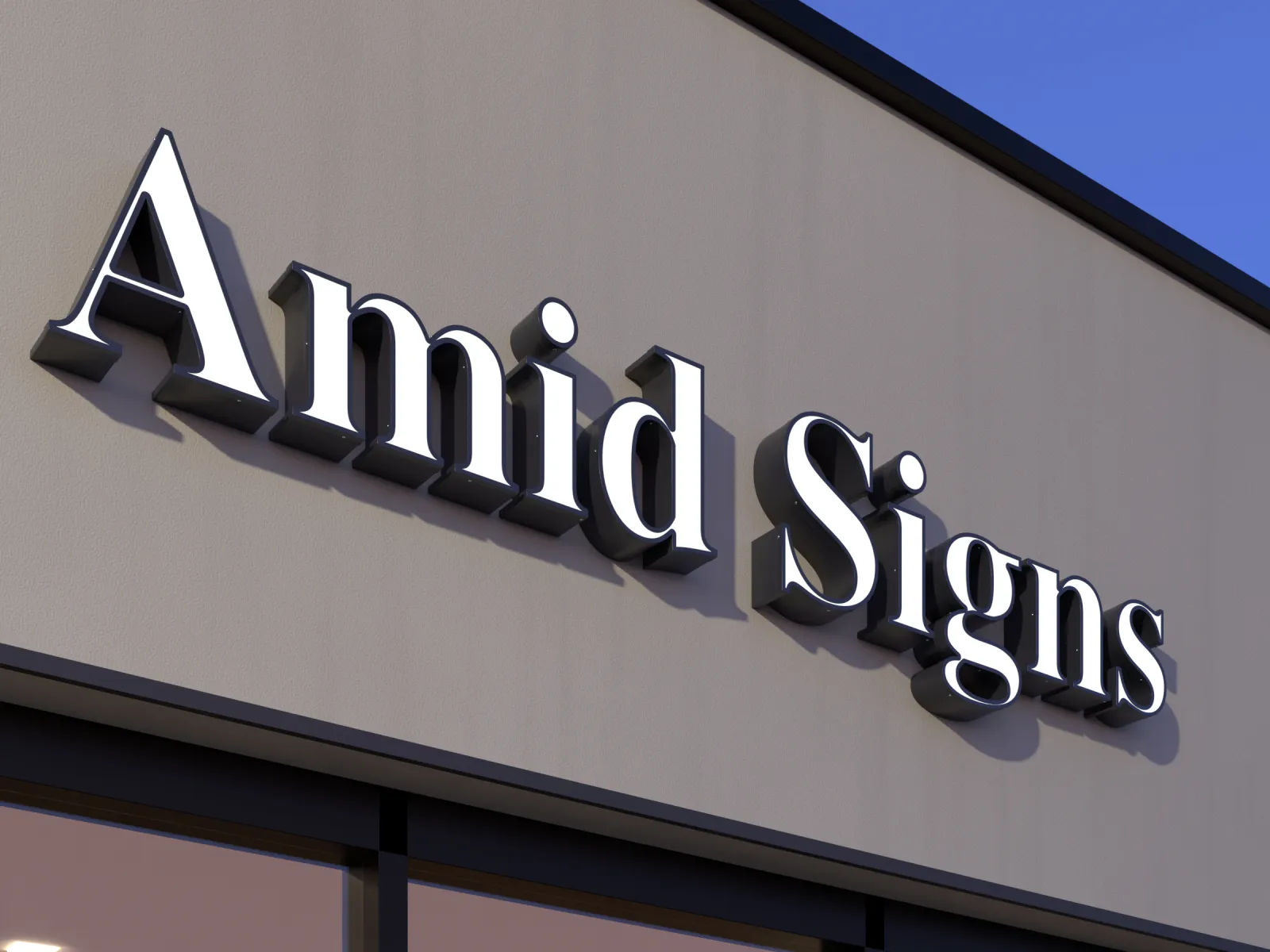
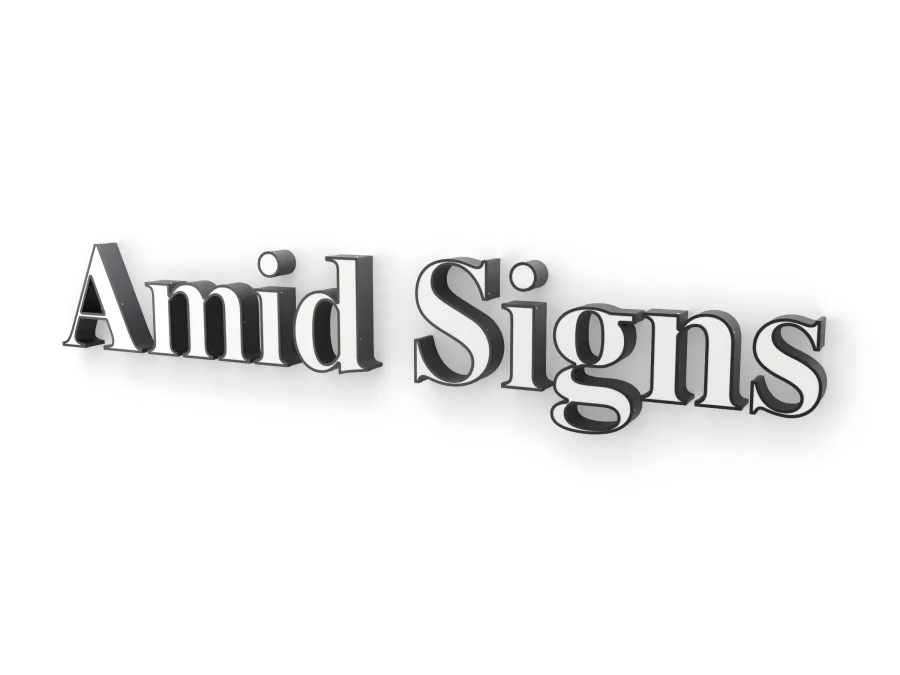
White front-lit channel letters reading Amid Signs on a storefront, seen from an angle
Sample sign. Your drawing uses your own name and logo.

What channel letters are

Individual 3D letters with the light built in.

Channel letters are individual, three-dimensional letters. Each one is a shallow metal shell cut and bent to the shape of a letter or a piece of your logo, with LEDs inside. The name comes from that shape: every letter is a channel that holds the light.

Because each letter stands on its own, the wall shows between them and the sign reads as your name, not as a box. You see channel letters on storefronts, shopping centers, office buildings and lobby walls.
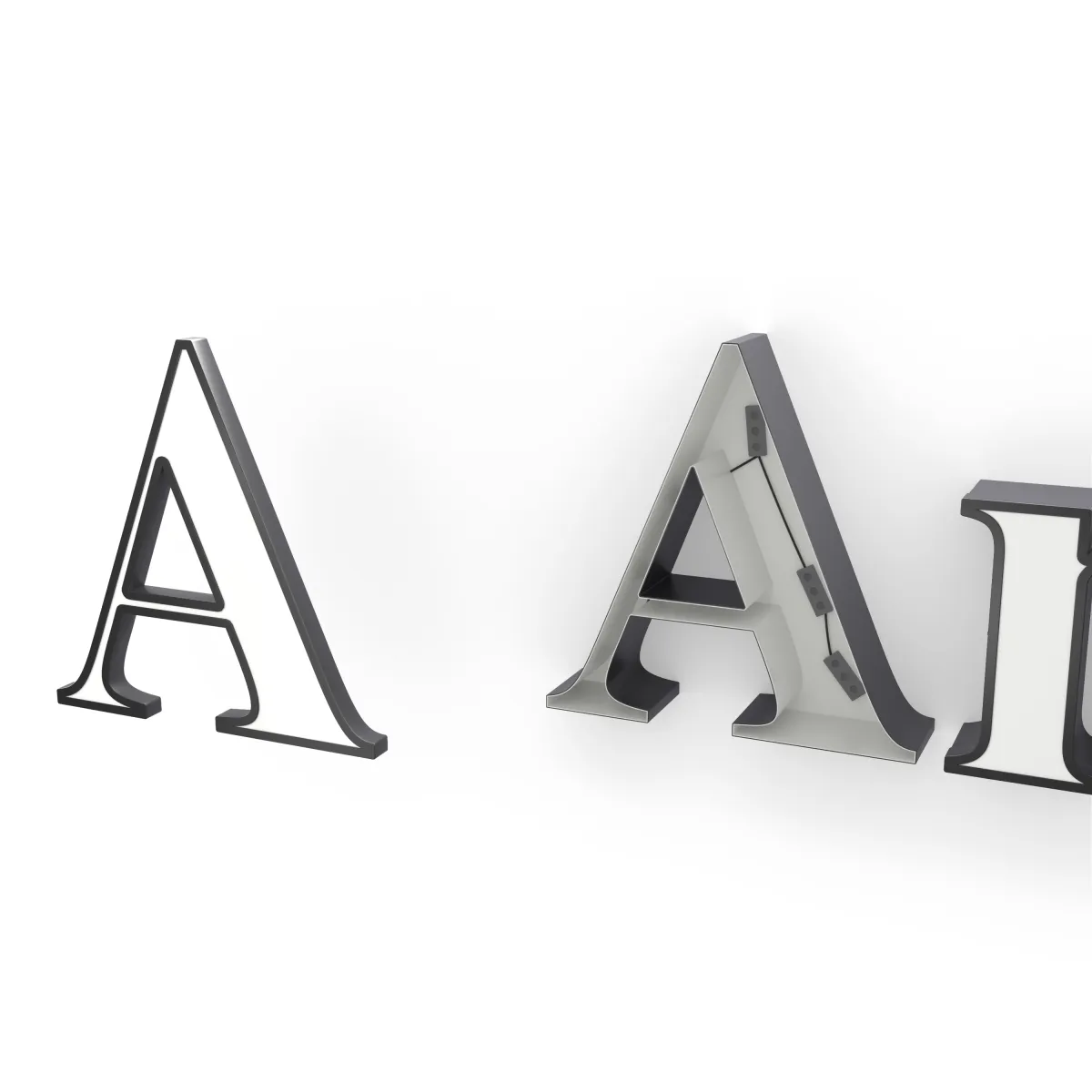
A front-lit letter taken apart: the face on the left, the stainless steel shell with LED modules and wiring inside on the right

How a channel letter is built

Face
The front of the letter. On front-lit letters it is acrylic that lets light through. On halo-lit letters it is solid steel printed with your artwork. Open-face letters have no face at all.
Returns (sides)
The sides of the letter, bent to follow its outline. On our letters they are 304 stainless steel. Their depth is what gives the letter its 3D look.
Back
The side against the wall. Halo-lit letters have an acrylic back so the light can glow onto the wall. On front-lit and open-face letters the back is part of the steel shell.
LEDs
Front-lit and halo-lit letters have LED modules wired inside each letter. Open-face letters have LED neon clipped along the middle of each stroke.
Power
The LEDs run from an LED power supply, also called a driver, which connects to your building’s electricity. Every part is listed on your drawing.
Mounting
Every letter mounts flush to the wall. A paper template shows where to drill, so nobody has to measure letter by letter.
The three lighting styles

The steel letter is the same. What changes is where the light comes out, and that decides where each style works best.

Front-lit letters on white background

Front-lit channel letters

Acrylic faces glow evenly inside 304 stainless steel returns. The whole letter lights up.

Choose it when: People read your name from the road, across a parking lot or from a moving car. Of the three styles, it reads from the farthest away.

Halo-lit letters on white background

Halo-lit channel letters

Solid steel faces printed with your artwork. Light shines out through an acrylic back and glows on the wall around each letter.

Choose it when: You want a polished look up close: a walkable street, a lobby, a reception wall. The glow shows best on a light, smooth wall.

Open-face neon letters on white background

Open-face neon channel letters

Open steel channels with LED neon clipped inside each stroke. You see the neon line and the polished steel around it.

Choose it when: You want the neon look in a solid metal letter: a feature wall, behind a bar or counter, a salon or a gym.

Side by side

FeatureFront-litHalo-litOpen-face neon
Where the light comes outThrough the faceOut the back, onto the wallFrom LED neon in an open channel
FaceAcrylicSolid steel, printed with your artworkOpen
By dayColored faces framed by steel returnsSolid letters in your colorsSteel channels with the neon line inside
At nightThe whole letter glowsDark faces outlined by a glow on the wallA line of light inside each stroke
Reads best fromFar away: the road, a parking lotClose to medium: the sidewalk, a lobbyClose to medium: a feature wall, a counter
MountingFlush to the wallFlush to the wallFlush to the wall

Front-lit vs. halo-lit: how to choose →

Why 304 stainless steel

We build every letter from 304 stainless steel, the most widely used grade of stainless steel. Here is why.

It resists rust

Stainless steel does not rust the way plain steel does, which is why it is used on building fronts, railings and kitchen equipment. It still likes an occasional wash, especially near the ocean or salted roads.

It looks like metal, because it is

By day the steel returns show, and halo-lit faces are solid steel. The letters read as metal lettering, not plastic.

One material for every style

Front-lit, halo-lit and open-face neon letters all start with a 304 stainless steel shell, so you can use one style outside and another inside and keep the same material.

Colors and finishes for stainless steel letters →

How big should your letters be?

Two things decide it: how far away people are when they read the sign, and how much wall you have.

Start with distance

A common rule of thumb for wall signs is about 1 inch of letter height for every 10 feet of viewing distance. Measure from where people first need to read the sign to the wall.

Then check the wall

Measure the usable width and height, not the whole building, and leave some wall showing on every side so the letters do not look cramped.

Know what “letter height” means

It is the height of a capital letter. Lowercase letters are shorter, and text in all capitals needs taller letters to read from the same distance.

Let the drawing settle it

You do not have to work it out alone. Send the wall width and a photo, and we suggest a size on your drawing.

Size guide and calculator →How to measure your wall →

What drives the cost

Every sign is built to order, so there is no single price for channel letters. These six things move it.

  1. Letter height

    Taller letters use more steel and more LEDs.

  2. Number of letters

    Each letter is built and wired on its own.

  3. Lighting style

    Each style is built from different parts.

  4. Finish and colors

    A special finish, printed artwork or several colors can change it.

  5. Logo detail

    Fine lines and many small pieces take more cutting and assembly.

  6. Indoor or outdoor

    Where the sign goes can change the parts we use.

Installation, permits and the electrician’s work are separate from the sign itself. Your exact price comes with your drawing, before you pay anything.

How pricing works →

Indoor or outdoor

The letters start the same way. What changes is the setting around them.

Indoors

People stand closer, so letters can usually be smaller. Room light is steady, so the glow shows all day, which is why halo-lit and open-face neon suit lobbies, reception desks and feature walls.

Outdoors

People are farther away, often in a car, so letters are usually bigger. By day, color and contrast carry the sign; after dark the light takes over. Sun, rain and dirt mean an occasional wash.

Tell us on the quote form where the sign goes. It can change the size we suggest and the parts we use.

Indoor vs. outdoor channel letters →

Installation

Every letter mounts flush to the wall: the back of each letter sits right against the wall surface. A paper template comes with your sign, so you mark the holes from the template instead of measuring each letter.

How the job goes

  1. Check that the wall is solid and flat, and find out what is behind it.
  2. Tape the template up, level it, and step back to check the position from where customers will see it.
  3. Mark and drill the holes shown on the template.
  4. Have the power connection made, then fix the letters to the wall.
  5. Turn the power on and check that every letter lights.

Power

Have a licensed electrician make the connection to your building’s electrical system, and ask your city whether that work needs its own permit or inspection.

How flush-mounted channel letters are installed →

Permits and approvals

Sign rules are local and differ from one city to the next. Ask before you order: it is much easier to size a drawing to the rules than to change a finished sign. Questions to ask your city and your landlord:

  • Do I need a permit for a new wall sign, and does lighting change the answer?
  • What is the maximum sign area, and how is it measured: around each word, or as one box around the whole sign?
  • Is there a limit on letter height, or on how many signs I can have?
  • Is lighting allowed at this address, and are there limits on brightness or hours?
  • Does my landlord, property manager or HOA have to approve the design first?
  • Who files the application, and does the electrical work need its own permit?

Sign permits: what to ask your city →

Care and maintenance

Channel letters need very little. A few habits keep them clean and working.

  • Wipe the letters with a soft cloth and mild soapy water, then rinse with clean water.
  • Skip scouring pads, steel wool and cleaners with bleach or chlorine. They can scratch or stain the steel and the acrylic.
  • On brushed steel, wipe along the grain lines, not across them.
  • If a letter goes dark or flickers, turn the power off and call an electrician instead of opening the wiring yourself.

How long LED channel letters last, and how to care for them →

How ordering works

Every order starts with a drawing you approve. Nothing is cut until you say yes.

  1. 1

    Send your logo and wall size

    Use the quote form. Any logo file works to start, even a photo of your current sign.

  2. 2

    Get a drawing and an exact price

    Your drawing shows letter sizes and colors, with a preview of the sign lit up.

  3. 3

    Approve and pay

    When it looks right, approve it and pay by card, or by bank transfer for larger orders.

  4. 4

    We build and ship

    Your letters are built from the approved drawing and come with a paper template for the mounting holes.

How it works, step by step →

Channel letters by type of business

Which style fits depends on where your customers first see you. Each page covers the usual picks and planning tips.

All businesses →

Guides

Step-by-step help for each part of the job, from choosing a style to hanging the letters.

All posts on the blog →

Channel letter questions

What are channel letters?

Individual three-dimensional letters. Each one is a shallow metal shell shaped like the letter, with LEDs inside. They mount on the wall one by one, so the sign reads as your name rather than as a box.

What is the difference between front-lit, halo-lit and open-face neon?

Where the light comes out. Front-lit letters glow through an acrylic face. Halo-lit letters have solid steel faces and glow onto the wall behind them. Open-face letters show a line of LED neon inside an open steel channel.

Which style is easiest to read from the road?

Front-lit. The whole face of each letter glows, so it reads from the farthest away. Halo-lit and open-face neon suit places where people are closer, like a sidewalk or a lobby.

What are your channel letters made of?

304 stainless steel. Front-lit faces are acrylic. Halo-lit faces are steel printed with your artwork, with acrylic on the back. Open-face letters have LED neon clipped inside.

How tall should my letters be?

A common rule of thumb is about 1 inch of letter height for every 10 feet of viewing distance, as long as the letters still fit your wall. Send the wall width and a photo and we suggest a size on your drawing.

How much do channel letters cost?

It depends on letter height, the number of letters, the lighting style, finish and colors, logo detail and indoor or outdoor use. Your exact price comes with your drawing, before you pay anything.

Do I need a permit for channel letters?

Often, especially outdoors, but the rules are local. Ask your city and, if you lease, your landlord before you order. Our permit guide lists the questions to ask.

Can I install channel letters myself?

The mounting is simple: the letters mount flush to the wall, with a paper template to mark the holes. Many owners hire a sign installer for work at height, and the power connection should be made by a licensed electrician.

See your name as channel letters

Send your logo and a photo of the wall. We reply with a drawing and an exact price.

Get a free quote