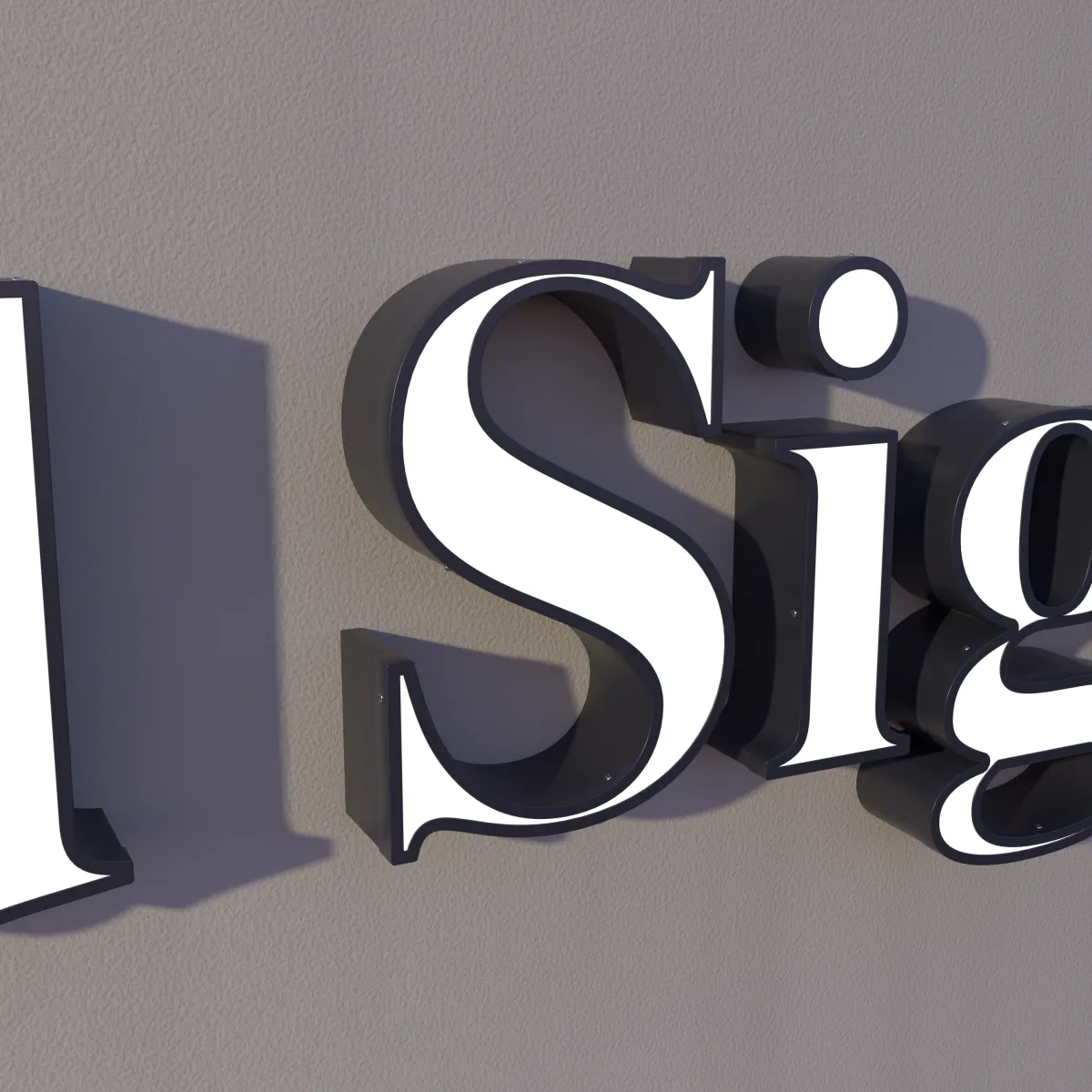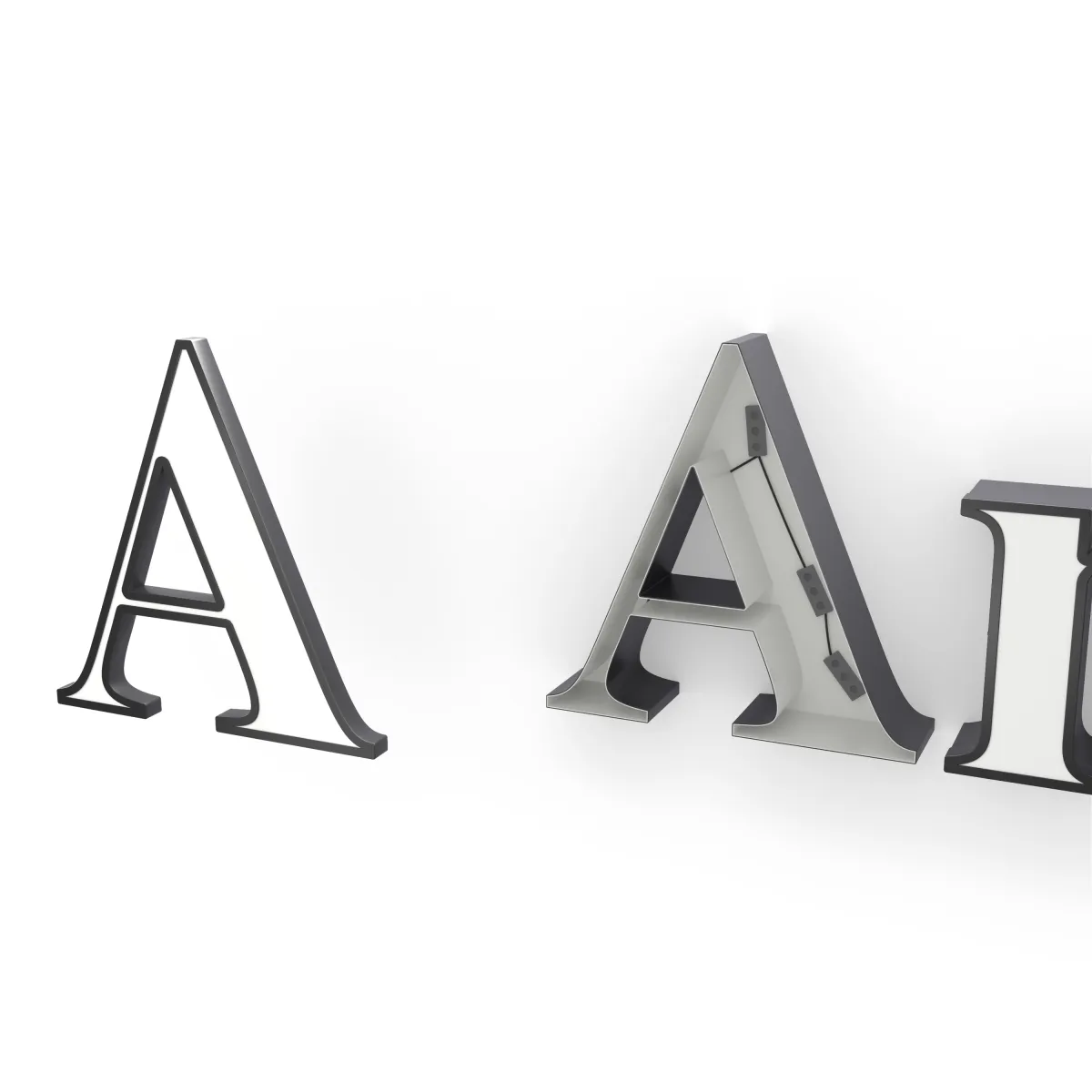
Every lit channel letter needs a power supply. You don’t have to be an electrician to buy a sign, but the basics help you plan the wall, the wiring and the electrician’s visit. This is general background: the instructions with your sign, your electrician and your local code come first.
What the power supply does
The LED modules inside channel letters, and LED neon, usually run on low-voltage direct current (DC), commonly 12 V or 24 V. Your building supplies line-voltage alternating current (AC): 120 V at a standard US outlet. The power supply converts one into the other. You may also hear it called an LED driver or, loosely, a transformer.
Whatever model is used, a lit sign has two sides:
| Side | Carries | Who usually handles it |
|---|---|---|
| Building side (input) | Line voltage, such as 120 V AC | A licensed electrician, for any hard-wired connection |
| Sign side (output) | Low voltage, such as 12 V or 24 V DC | Your sign installer or electrician |
Sizing: leave headroom
A power supply is rated in watts. To size one, you add up the watts of all the LEDs it feeds, then choose a supply rated comfortably above that total, so it isn’t working at its limit. A supply run at full capacity all the time gets hot and wears out sooner.
The supply also has to match the voltage of the LEDs: 12 V modules need a 12 V supply, 24 V modules a 24 V one.
The power supply for your letters is listed on your drawing. If one is ever replaced, the new one should match the voltage and keep that headroom.
Where the power supply goes
With flush-mounted letters, the wires usually pass through the wall behind each letter, and the power supply sits behind the wall or in an enclosure nearby. A few things shape the spot:
- Short low-voltage runs. Low-voltage wire loses some voltage along its length, so LEDs at the end of a long run can look dimmer. That’s why the supply usually sits close to the letters. At the same wattage, 24 V systems carry half the current of 12 V systems, so they can run farther on the same wire.
- Air around it. Power supplies give off heat. One shut in a tight space with no airflow runs hotter and may not last as long.
- A way to reach it. US electrical code generally calls for sign power supplies to be accessible and securely fastened in place. Don’t plan to seal one behind a finished wall with no access.
- Power already there. In many commercial buildings there is already a circuit meant for a sign; US electrical code generally calls for a sign outlet at each tenant entrance that’s open to people on foot. Ask your landlord or electrician before you choose the exact spot for the sign. It’s item 9 on our storefront sign checklist.
Planning a sign for a lobby instead? Reception wall logo signs covers the wall, the light and the power for indoor logos.
Outdoors and damp places
A power supply outside, or anywhere it can get wet, has to be made for that location.
- Check the IP rating. IP (ingress protection) ratings use two digits: the first for dust, the second for water. IP65 means dust-tight and protected against low-pressure water jets. IP67 means dust-tight and protected against temporary immersion.
- Potted supplies. Many sign power supplies are potted: the electronics are sealed in a compound that keeps out moisture and dust. Some are still meant to be installed under cover, so check where yours is designed to go.
- Temperature. Every supply has an operating temperature range; compare it with your local summers and winters.
If your sign goes outdoors or somewhere damp, say so on the quote form. It can change the parts we use, and your drawing lists the power supply.
Dimming and timers
Not every power supply can dim. Dimming needs two matching parts: a dimmable power supply, and a dimmer made for the same dimming method — for example, a phase-cut wall dimmer, a 0–10 V control, or a low-voltage dimmer on the sign side. A standard wall dimmer on a non-dimmable supply can cause flicker, buzzing and a shorter life.
So decide before you order, and ask us about dimming when you request a quote. Rooms where brightness matters, such as waiting rooms and salons, are covered on our pages by type of business.
Timers and photocells (light sensors) are a common way to turn a sign on at dusk and off at a set time. Your electrician can wire one into the sign’s circuit.
Who connects it
A sign either plugs into an outlet or is hard-wired into the building’s electrical system. Have a licensed electrician make the power connection.
- Hard-wired connections are a job for a licensed electrician. Ask your city whether the connection needs its own electrical permit or inspection — see Sign permits: what to ask your city.
- A way to switch it off. US electrical code generally requires a switch or breaker that cuts power to the sign, within sight of it — or, where it can’t be seen from the sign, one that can be locked in the off position. Your electrician will know what applies where you are.
Your drawing lists the power supply for your letters. The electrician who connects it is not part of our price — see pricing. Installation steps are in How flush-mounted channel letters are installed.
Questions to settle before you order
| Question | Why it matters |
|---|---|
| Where is power at the wall today? | It decides where the supply goes and how long the wires run |
| Indoors, outdoors or under cover? | The supply has to suit the location |
| Do you want to dim the sign? | It needs a dimmable supply and a matching dimmer |
| Who makes the connection? | Hard-wired means a licensed electrician |
| Can the supply be reached later? | For service, and to meet code |
When you ask for a quote, note where the power is on the quote form. Every part, power supply included, is listed on your drawing, and nothing is made until you approve it.